01
Modality use is architecture-specific.
All four policies use images, instructions, and history, but their dependence and progress-tracking patterns differ.
* Equal contribution. Listing order is random.
Spotlight CoRL ’26 workshop The Science of Physical AI Safety · SPAIS 2026 ↗Abstract
Modern Vision-Language Navigation (VLN) models rely mostly on pre-trained large Vision-Language Models (VLMs) to predict navigation actions. While this fusion of language instructions and visual observations allows multimodal reasoning, it obscures how information is routed across modalities or what mechanisms drive navigation decisions. Thus, it remains unclear whether VLN models ground their predictions in relevant semantic cues or can track task progress. In this work, we study the interpretability and steerability of VLN models. We use intervention-based metrics that measure how visual observations, instructions, and visual memory causally influence navigation decisions. Our results show that these navigation policies are sensitive to all input modalities and do not depend on a single one. We further show that these agents encode navigation progress and retain semantic structure from their VLM backbones, enabling concept-level steering through internal activations. Finally, we extract activation vectors for abstract behaviors to transfer them zero-shot to out-of-distribution real-world scenarios, improving performance without additional fine-tuning.
The question
Success alone does not reveal whether a policy grounded the instruction, used a shortcut, or recovered through another modality. Under distribution shift, a failed behavior may be absent or encoded but unused.
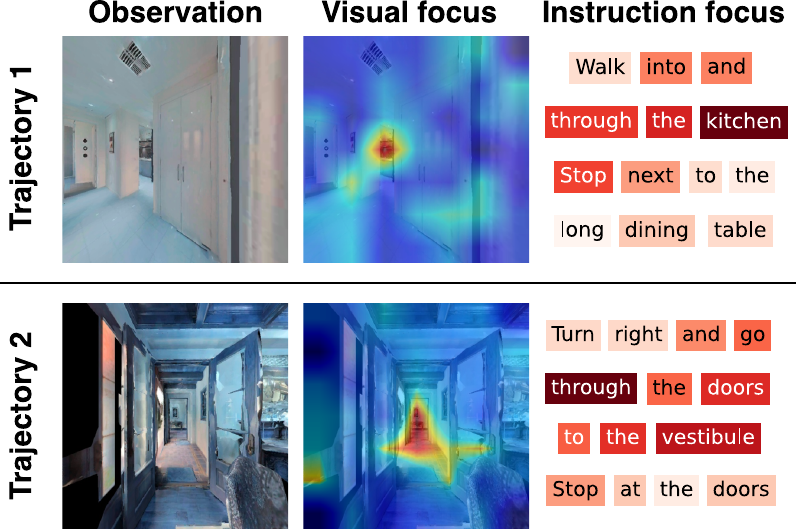
Main findings
All four policies use images, instructions, and history, but their dependence and progress-tracking patterns differ.
An intervention can change one action without causing the largest drop in closed-loop success.
Navigation-associated value vectors remain, and clamping their neurons shifts motion behavior.
A visual shift reduces reasoning from 12% to 3%; a simulation-derived direction restores it and transfers to the robot.
Explainer video
Method overview
We change one input component, rerun the unchanged policy, and measure the trajectory difference. This tests causal influence more directly than attention alone.
Use the current image, instruction, and visual history.
Blur visual content or modify an instruction span.
Keep the model weights and remaining context fixed.
Compare trajectories by position and orientation.
| Method | Question | Use in this study |
|---|---|---|
| ISS | How much does the path change after an input intervention? | Behavioral attribution for images, instructions, and memory. |
| Integrated Gradients | How does fixed-output likelihood change from a corrupted to original input? | Gradient-based visual reference. |
| TAM | Which input tokens support a generated output token? | Token-level localization, especially for concrete concepts. |
Attribution probes the inputs; steering tests whether a retained representation can change behavior without updating weights.
Semantic steering
Project value vectors through the language head, select neurons associated with navigation concepts, and clamp positive and negative groups.
Behavior steering
Subtract the mean action state from the mean reasoning state, then add that direction at the target layer. α sets its strength.
Evidence from the paper
Visual attribution → progress tracking → retained semantics → recovery under distribution shift.
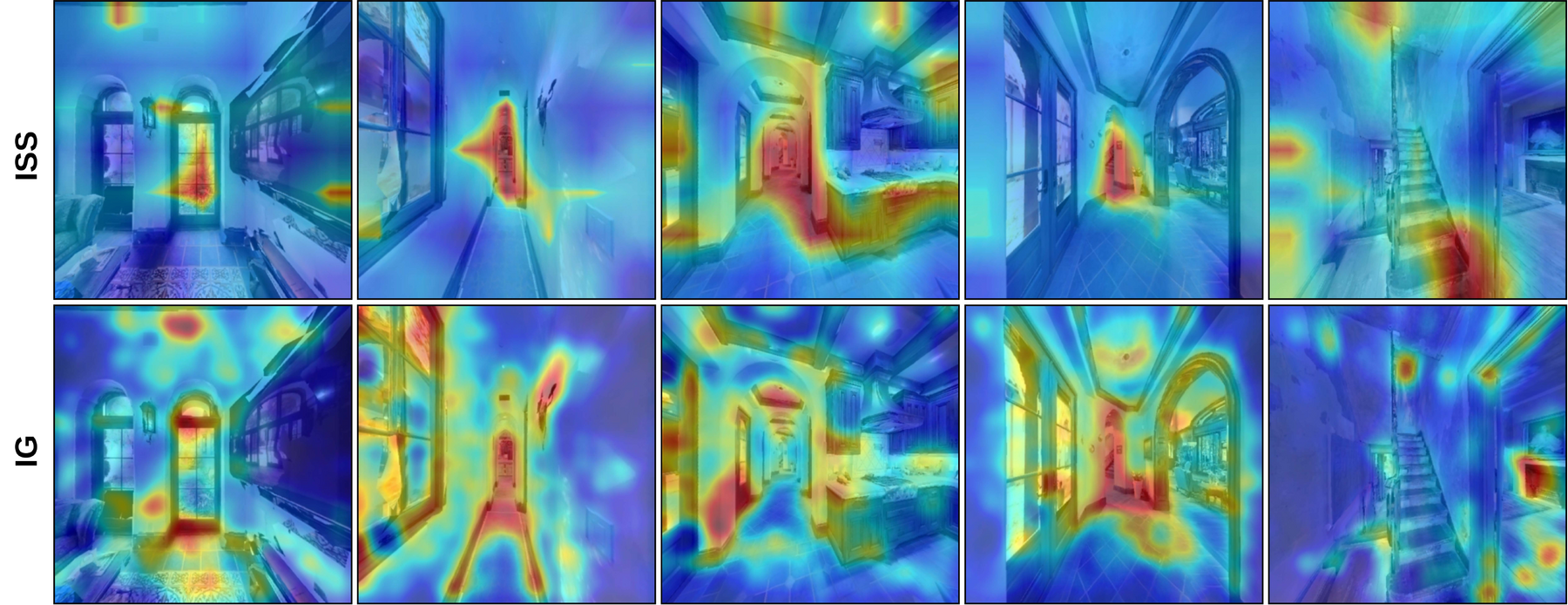
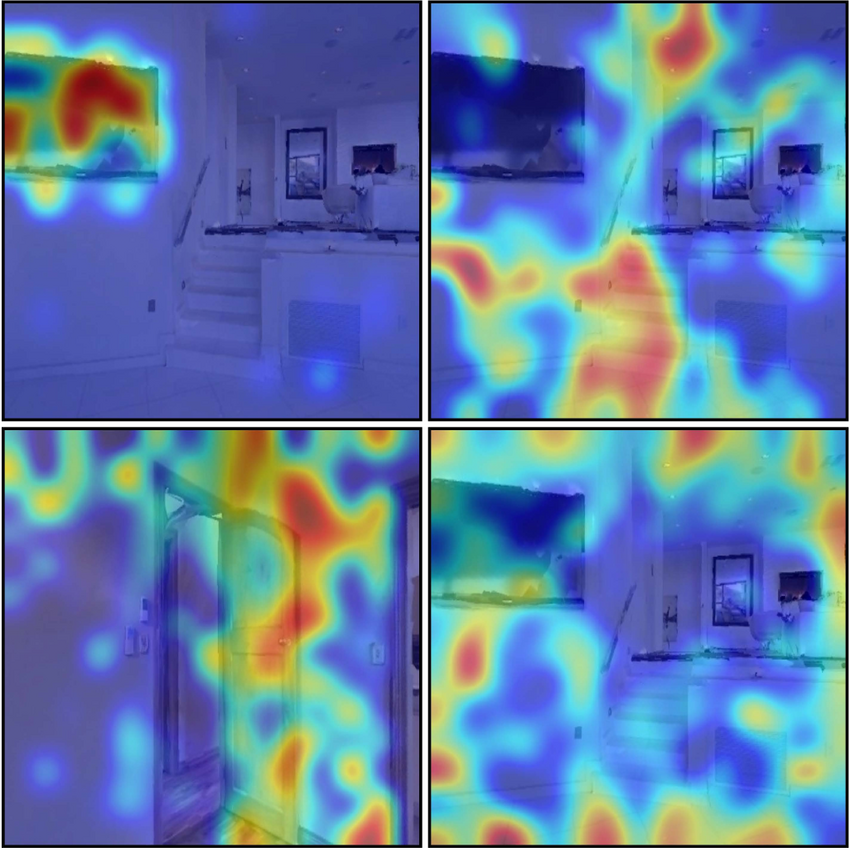
We evaluate ISS and IG on 200 decisions with human-marked evidence regions.
We corrupt earlier observations or instruction spans and measure action change over trajectory progress.
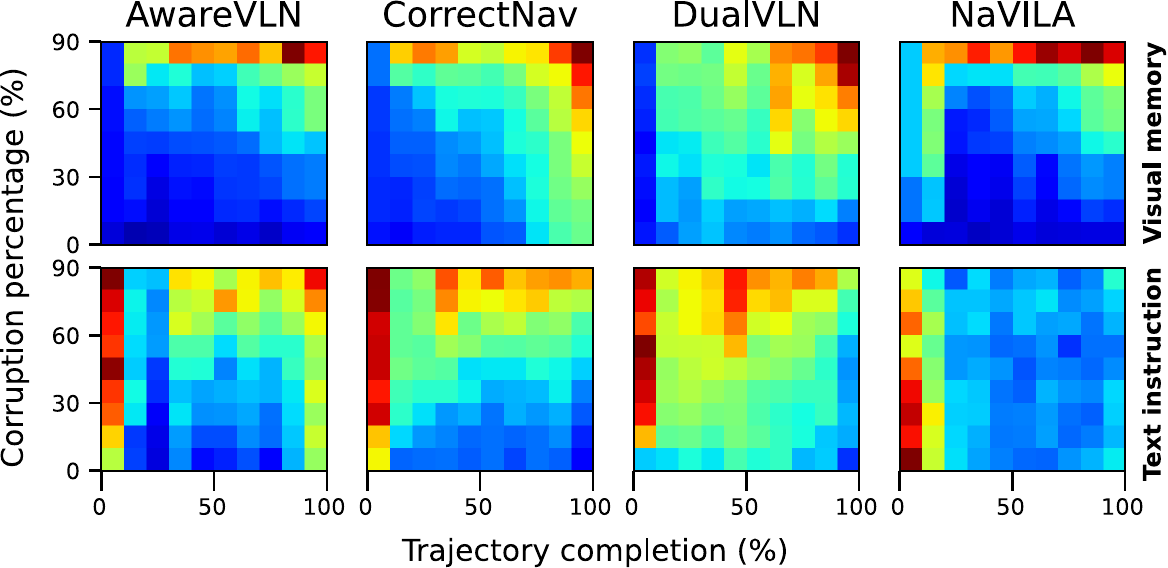
CorrectNav and DualVLN increasingly use distributed visual history. AwareVLN and NaVILA depend more on recent observations.
Language-progress patterns also vary, reflecting differences in memory, temporal encoding, reasoning, and action horizons.
We find navigation-associated FFN value vectors, then intervene on their neurons.
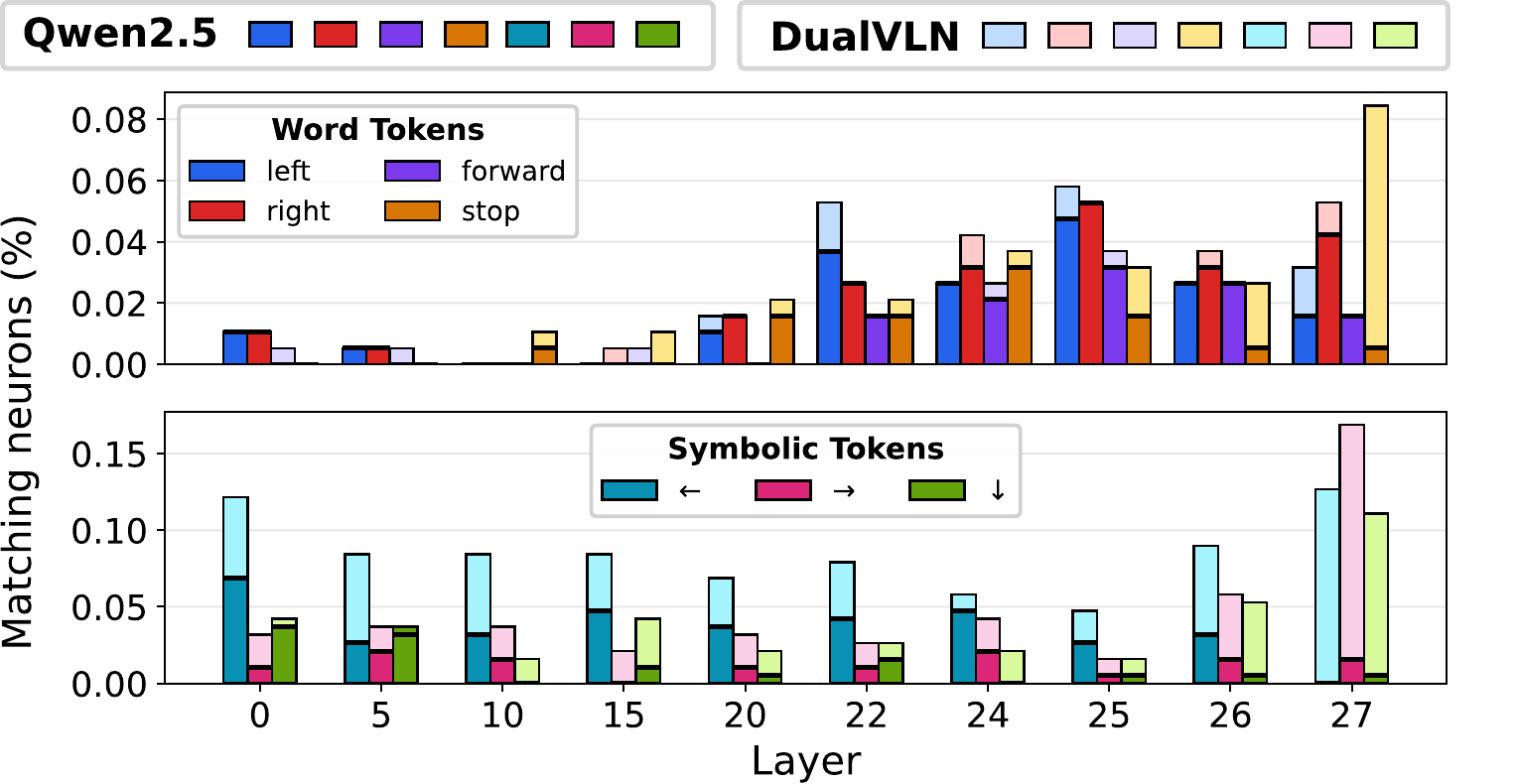
Words such as forward, left, right, and stop persist after DualVLN fine-tuning. Symbolic arrows become more visible in later layers.
Projection is correlational. Clamping the selected neurons shifts motion-token frequencies, showing causal influence.
| Steering contrast | Forward | Right | Left |
|---|---|---|---|
| forward positive / turn negative | +3.2% | -0.8% | -19.3% |
| left positive / right negative | +0.8% | -3.0% | +7.8% |
We compare matched simulator states under the training camera and a robot-like fisheye camera.
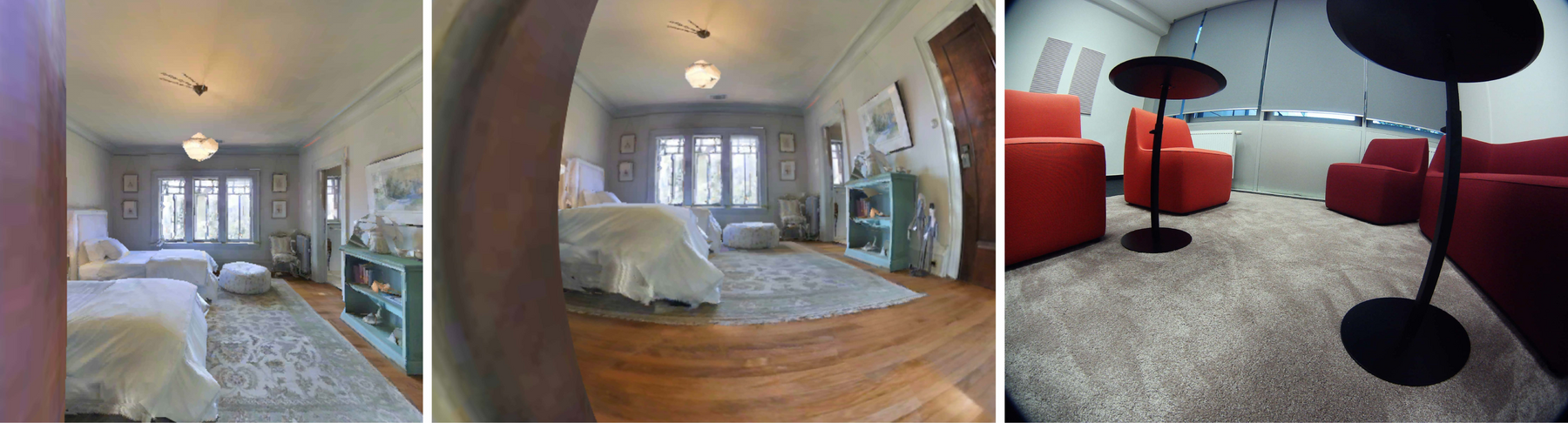
Reasoning falls from 12 ± 2% to 3 ± 1%. Adding a simulation-derived action-to-reasoning activation direction restores it as α increases.
A random direction does not produce this effect, linking recovery to the learned direction rather than perturbation alone.
| Condition | α=.5 | α=1 | α=2 | α=4 |
|---|---|---|---|---|
| Nominal camera | 12 ± 2% | |||
| Visual shift | 3 ± 1% | |||
| Random direction | 3.0% | 2.7% | 2.6% | 1.6% |
| Mean reasoning direction | 20% | 55% | 90% | 100% |
Real-world deployment
The reasoning direction is computed in simulation and applied without robot-specific steering data or weight updates.
The baseline runs first; an operator enables steering after an uncorrected wrong choice or loop. This is a sequential recovery protocol, not two independent policy runs.
For the community
Pair fixed-state interventions with closed-loop evaluation.
ISS, IG, and TAM expose different input–output relationships.
A shifted policy may retain a useful internal capability.
Citation
@misc{makowski2026vlmbasedvisionlanguagenavigationmodels,
  title         = {What do VLM-Based Vision-Language Navigation Models Rely on:
                   Interpreting and Steering Policy Behavior},
  author        = {Débora Oliveira Makowski and Samiran Gode and Abhijeet Nayak
                   and Marco Hutter and Cordelia Schmid
                   and Lukas Rosenberger Schmid and Wolfram Burgard},
  year          = {2026},
  eprint        = {2609.24576},
  archivePrefix = {arXiv},
  primaryClass  = {cs.RO},
  url           = {https://arxiv.org/abs/2609.24576}
}