Norm2Tex: Augmenting Visuo-Tactile Simulations with Texture

*Equal contribution · University of Technology Nuremberg · TU Dresden · Deggendorf Institute of Technology
Vision-based tactile simulation and sim-to-real transfer
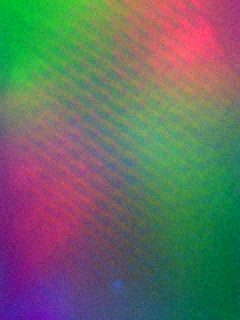
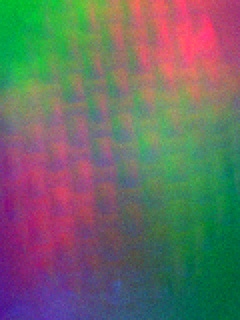
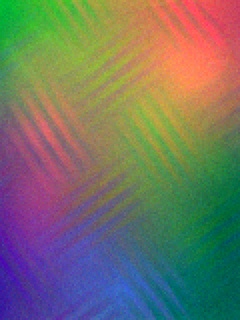
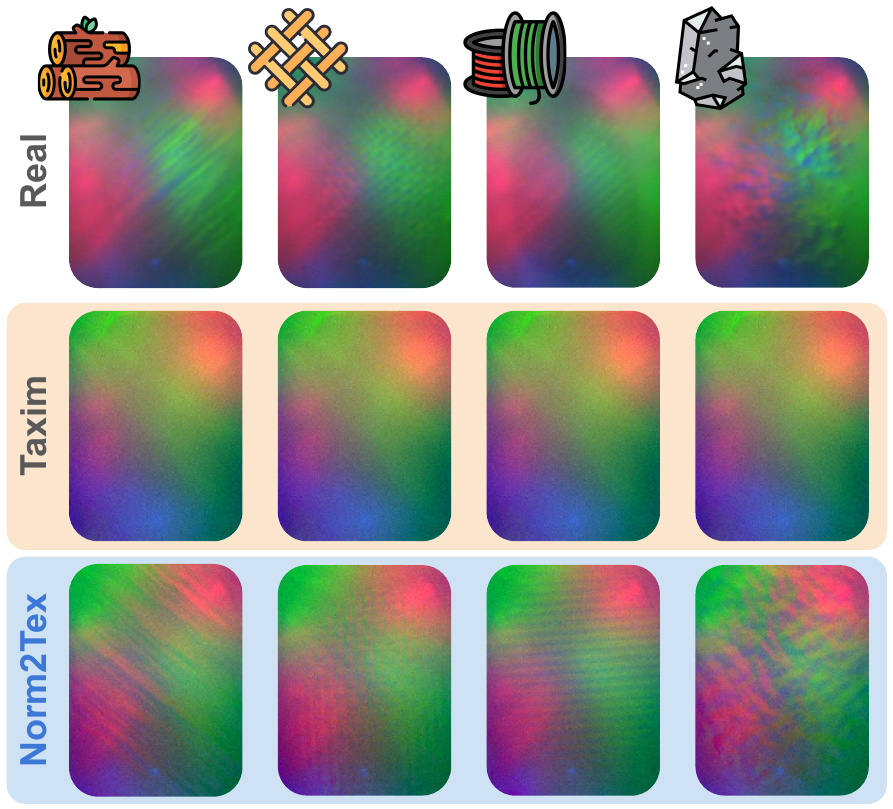
Real, textureless simulated, and Norm2Tex tactile images

Norm2Tex adds spatially consistent high-frequency surface detail to existing tactile simulators.

TL;DR

Adding texture to tactile simulations

Large-scale tactile datasets are expensive because useful observations require repeated physical contact. Existing simulators reproduce deformation caused by contact, but omit high-frequency surface detail such as fabric weaves, wood grain, or surface artifacts.

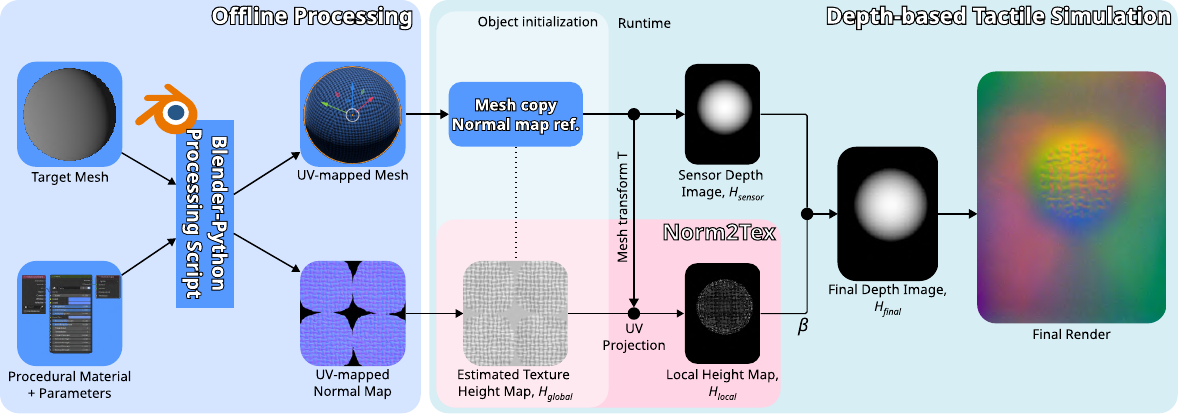
Norm2Tex is a plug-in layer that augments a simulator's depth representation with texture from a UV-matched normal map. It leaves the original contact and rendering pipeline intact, with proven sim-to-real transfer.

72.8%zero-shot material accuracy
TACTO · Taximdrop-in integrations
03 · Materials

One material, many surfaces

Freely available meshes often include an RGB map but no high-resolution surface geometry. We instead construct procedural materials with control scale, direction, and local variation. We then export RGB textures, normal maps, and UV-adjusted meshes for simulation.

The same material family can be varied to increase diversity while preserving the spatial relationship between the object and its tactile texture.

FabricWoodAcrylicRock3D print
02 · Method

A plug-in texture layer before rendering

Norm2Tex keeps texture anchored to the object throughout the simulation:

  1. Initialize: convert a UV-matched normal map into a global height map.
  2. Query contact: use the object pose to sample the surface region touching the sensor.
  3. Render: add the local texture height to the simulator depth map.

The textured depth image then continues through the original tactile renderer.

Texture injection
\[H_{\mathrm{final}} = H_{\mathrm{sensor}} + \beta H_{\mathrm{local}}.\]
Texture remains spatially consistent as contact moves.
Norm2Tex architecture
01

Generate

Procedural Blender materials create UV-matched normal maps for arbitrary meshes.

02

Reconstruct

Normal-derived gradients are integrated into a pseudo-height map.

03

Render

The local height map is added before the simulator's original renderer.

05 · Video rollouts

Policy behavior across materials

Target is to open yet hold before it drops.

Wood
Acrylic
Fabric
Blind policy
Blind · Wood
Blind · Acrylic
Blind · Fabric
Taxim policy
Taxim · Wood
Taxim · Acrylic
Taxim · Fabric
Norm2Tex policy
Norm2Tex · Wood
Norm2Tex · Acrylic
Norm2Tex · Fabric
Citation

BibTeX

@misc{bien2026norm2tex,
      title={Norm2Tex: Augmenting Visuo-Tactile Simulations with Texture}, 
      author={Seongjin Bien and Débora Oliveira Makowski and Roberto Calandra and Florian Walter and Wolfram Burgard},
      year={2026},
      eprint={2609.25398},
      archivePrefix={arXiv},
      primaryClass={cs.RO},
      url={https://arxiv.org/abs/2609.25398}, 
}